The handoff that broke in front of the client
The process in the founder’s head, written down as a file that code runs, with a person at the gate and only approved work reaching the client’s folder.
An independent customer-experience studio in Southern California, under 20 people, founder-led. It designs onboarding for membership organizations and professional-services firms, and its whole pitch is that no customer falls through the handoff between teams. Then a client opened the shared review folder and found a draft on last year’s template, sitting next to the studio’s internal QA notes.
Before
The founder is the process. Every account runs the way the founder would run it, because the founder taught each person how, out loud, 1 handoff at a time. Nothing is written down that a new hire could execute. The work moves on memory: which template is current, whether the intake had an audience, whether anyone with taste read it before it went out.
When it breaks, it doesn’t break at the start. It breaks at the end, at the release, where the client can see it.
They had tried the obvious fixes. First, the founder read everything before release. That held until the studio grew past what 1 person can read in a day, and the founder became the queue. Then a checklist per deliverable in the project tool. People ticked the boxes from memory, so the checklist recorded what people remembered, not what happened.
The morning after the review-folder call, the founder issued a mandate with no spec behind it: write down how the studio does everything, and let AI run it. A studio that sells clean handoffs had just dropped a handoff in front of a client. The mandate was the right instinct. It was also a sentence, not a plan.
What was done
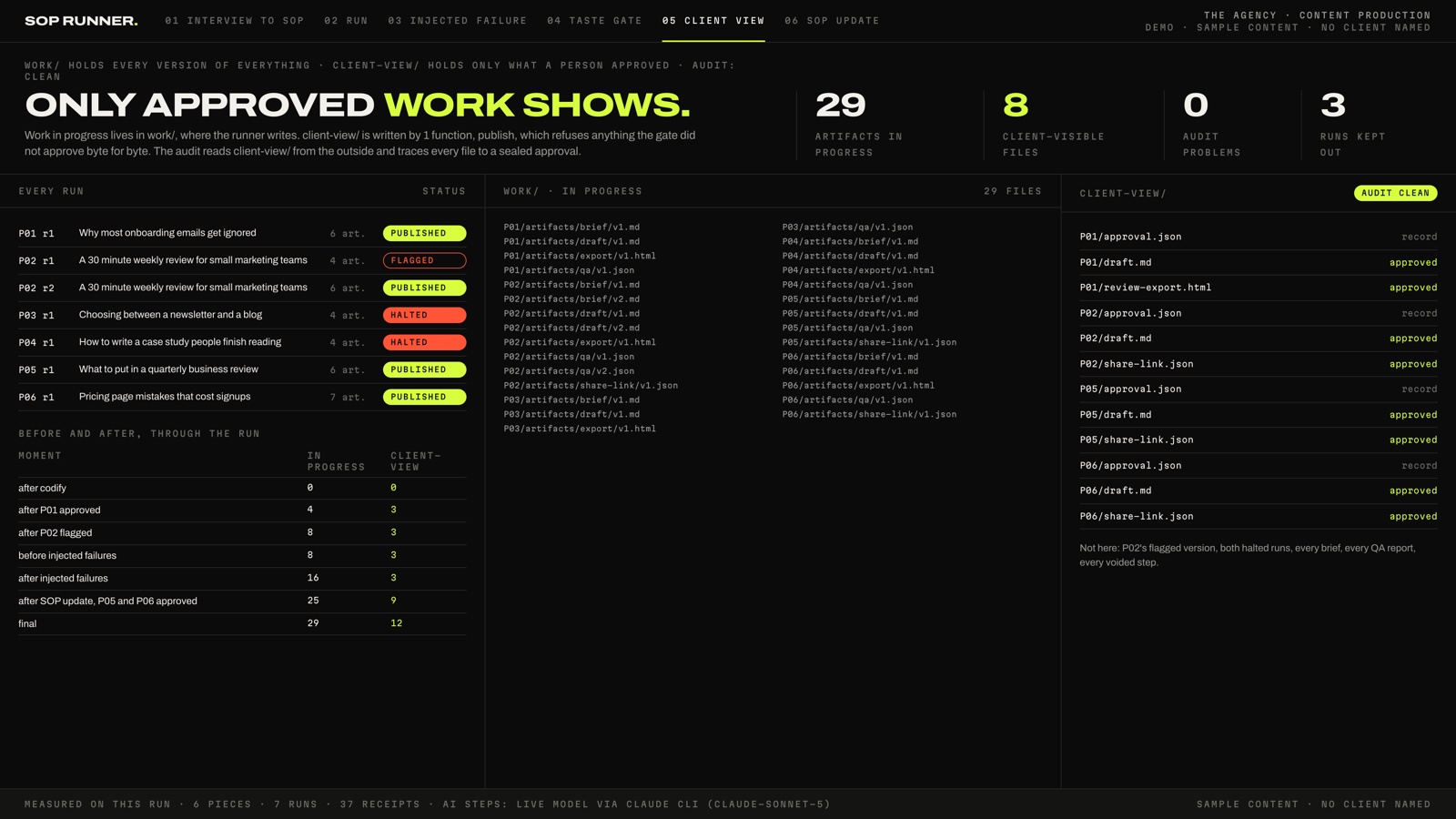
We didn’t start with the SOPs or with a model. We started where the failure landed: the client’s folder. The first rule: nothing reaches that folder unless a named person approved those exact files.
Then 1 process, not all of them: a content piece, from request to the client’s folder. The founder explained it once, in an interview. A model turned the interview into an SOP file, and code checks that file against hard rules before it’s allowed to exist: there’s a named human gate, publish comes last and only after the gate, and every step’s inputs come from the intake, a pinned template, or an earlier step.
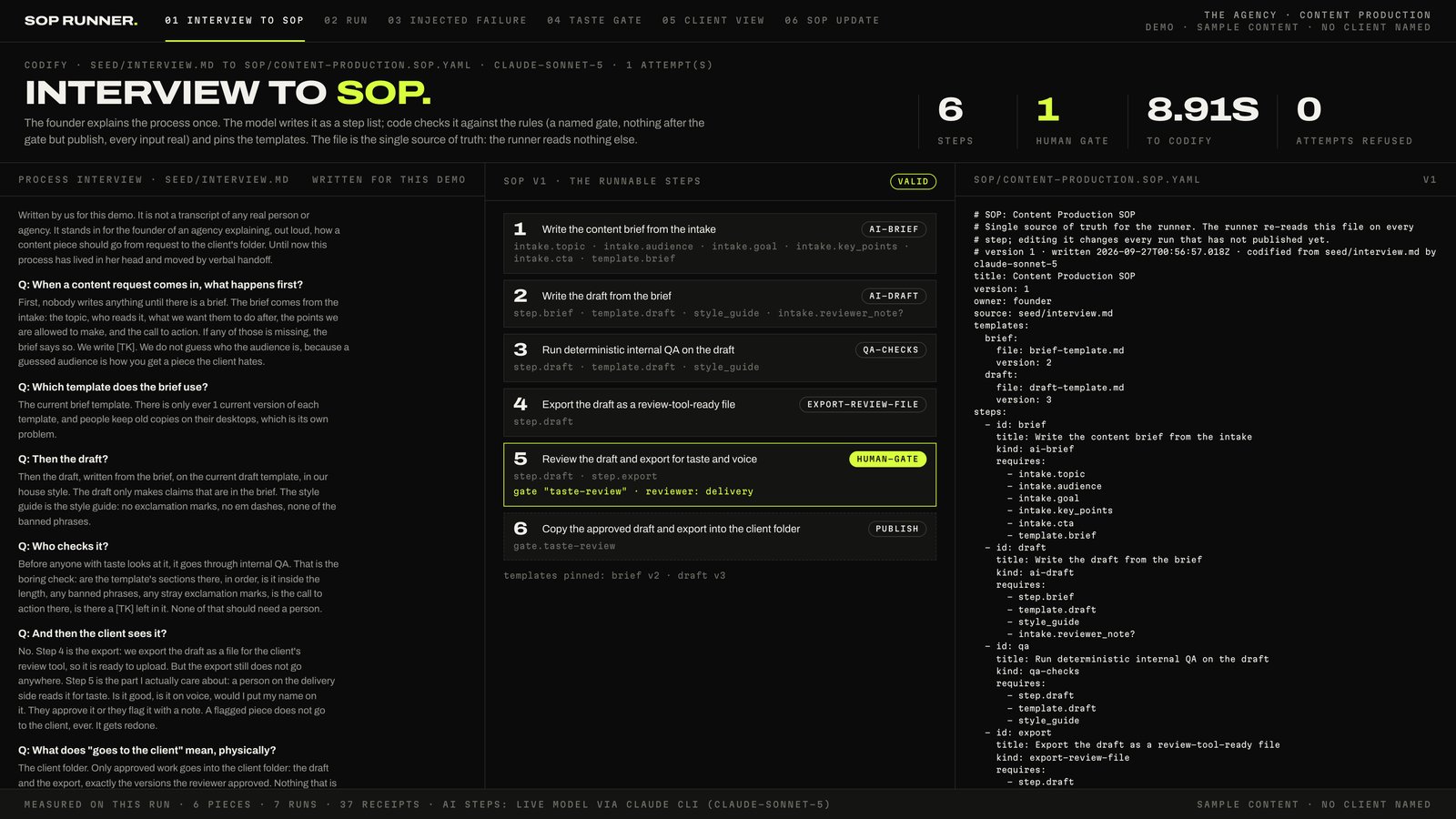
The founder plays every instrument on the record. On stage there’s a band, and the band needs the charts.
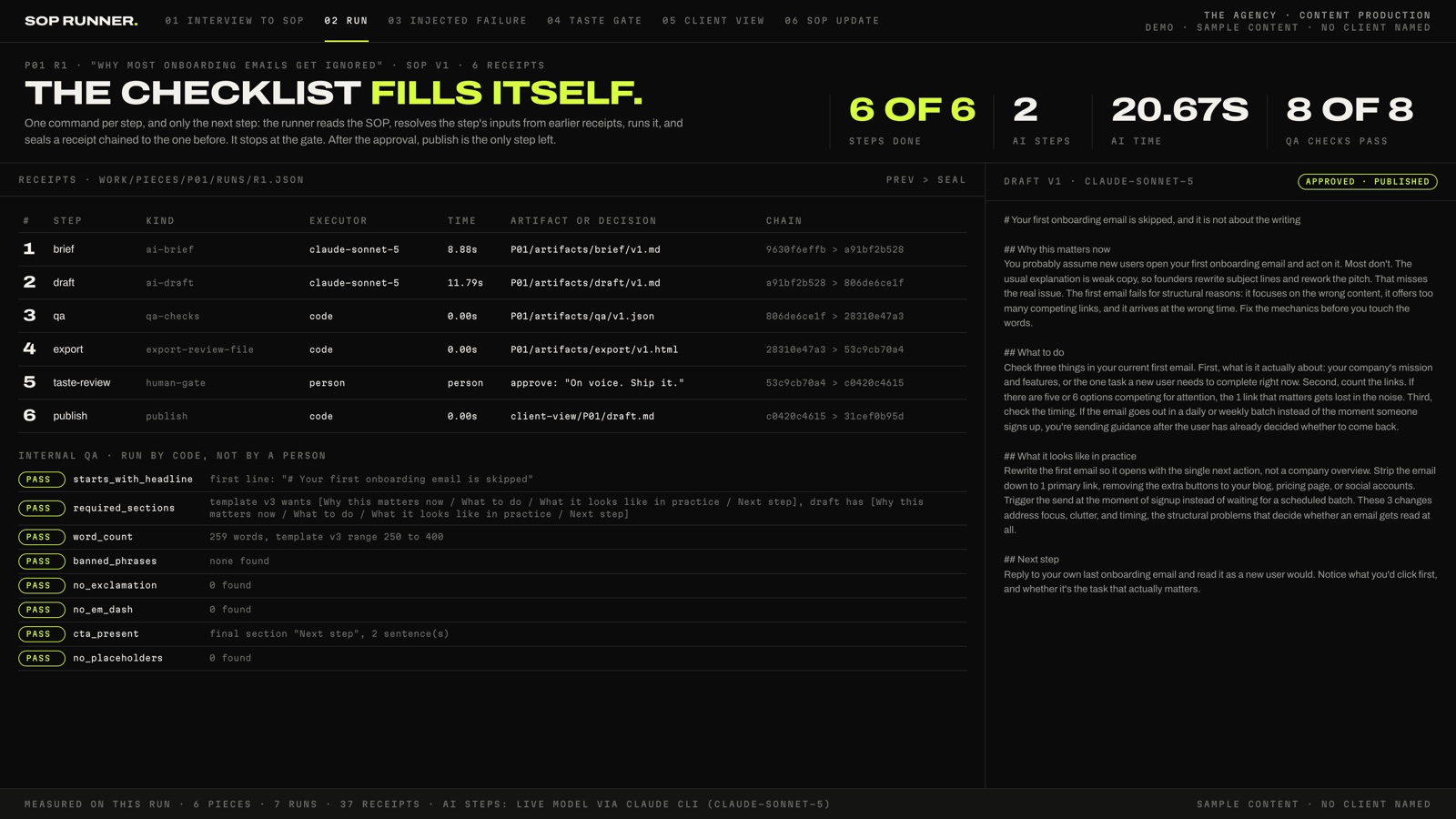
The runner executes that file 1 step at a time: brief, draft, internal QA, export, the gate, publish. There is no “run step 4” command. It can only advance, each step writes a sealed receipt, and a skipped or reordered step halts the run.
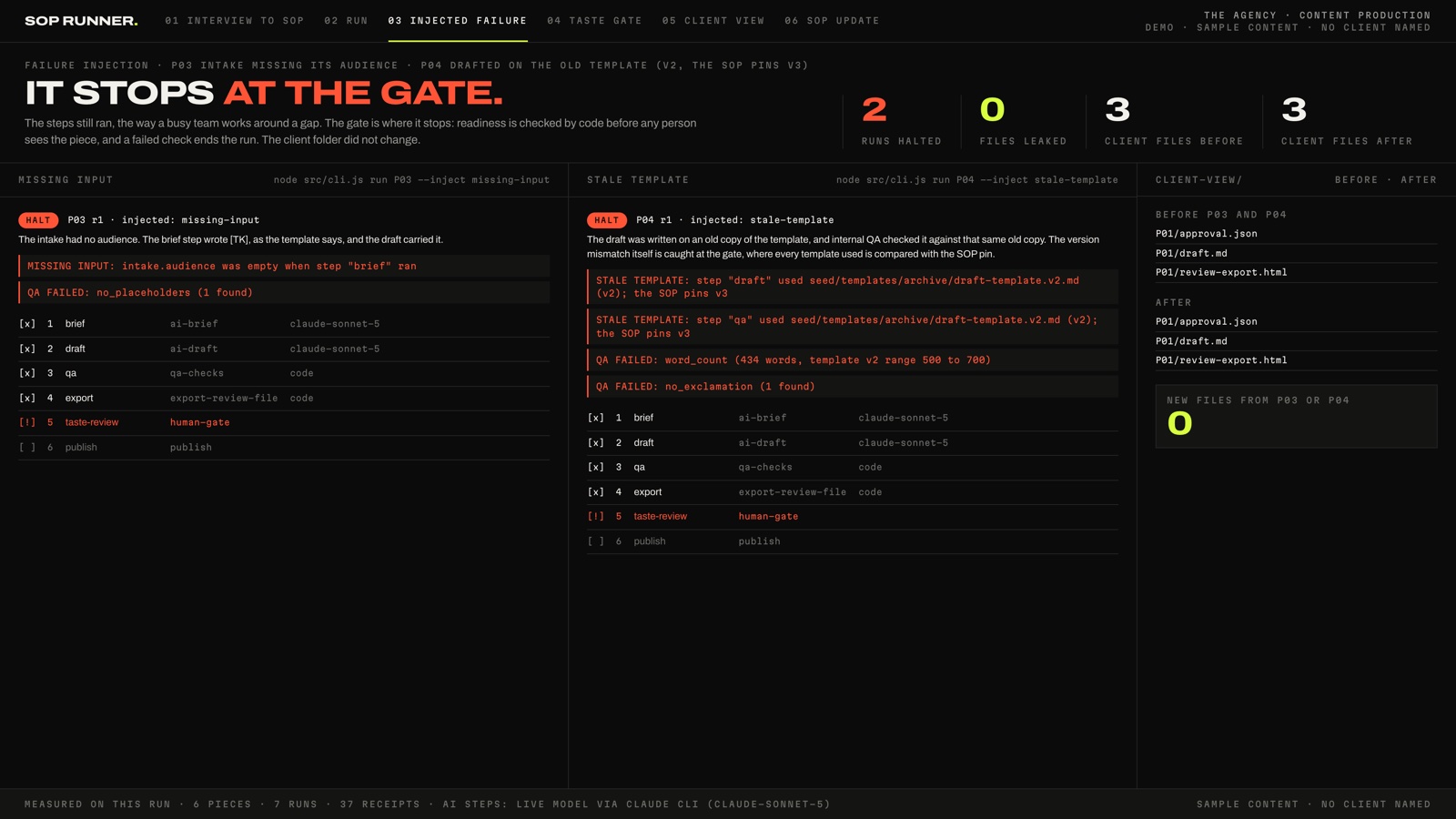
Then we broke it on purpose, the 2 ways the founder said it always breaks. 1 intake arrived with no audience. 1 draft was written on the old template. Both ran all the way to the gate, the way a busy team works around a gap. Both stopped there, loudly, with the reason printed. A halted run can’t be approved.
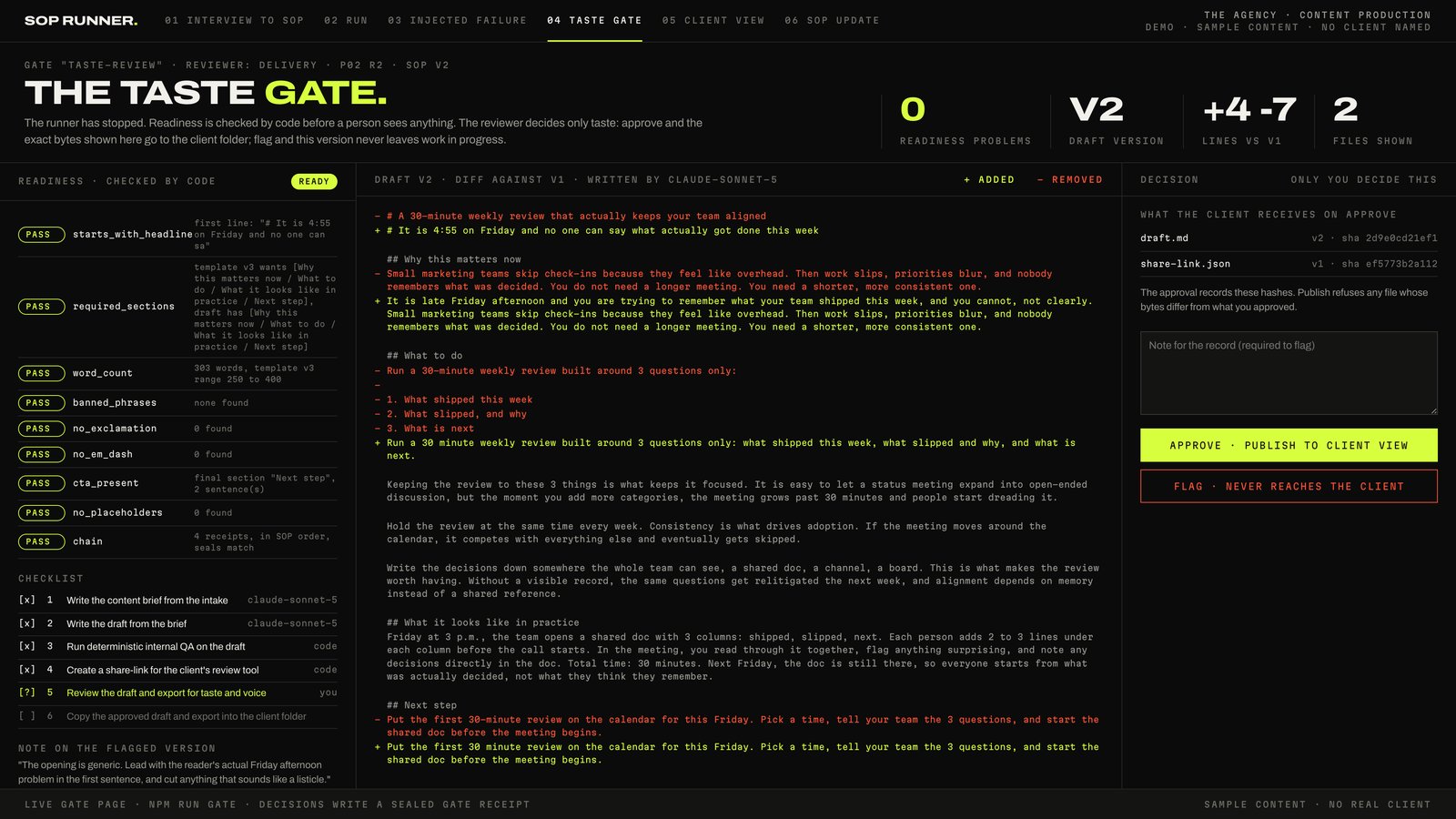
This is where the team’s job turns over. The delivery lead stops carrying the sequence in their head. Code checks readiness before a person sees anything. The person decides only what code can’t: is it good, is it on voice, would the founder put their name on it. Approve, and the exact bytes on screen go to the client. Flag it with a note, and that version never leaves work in progress.
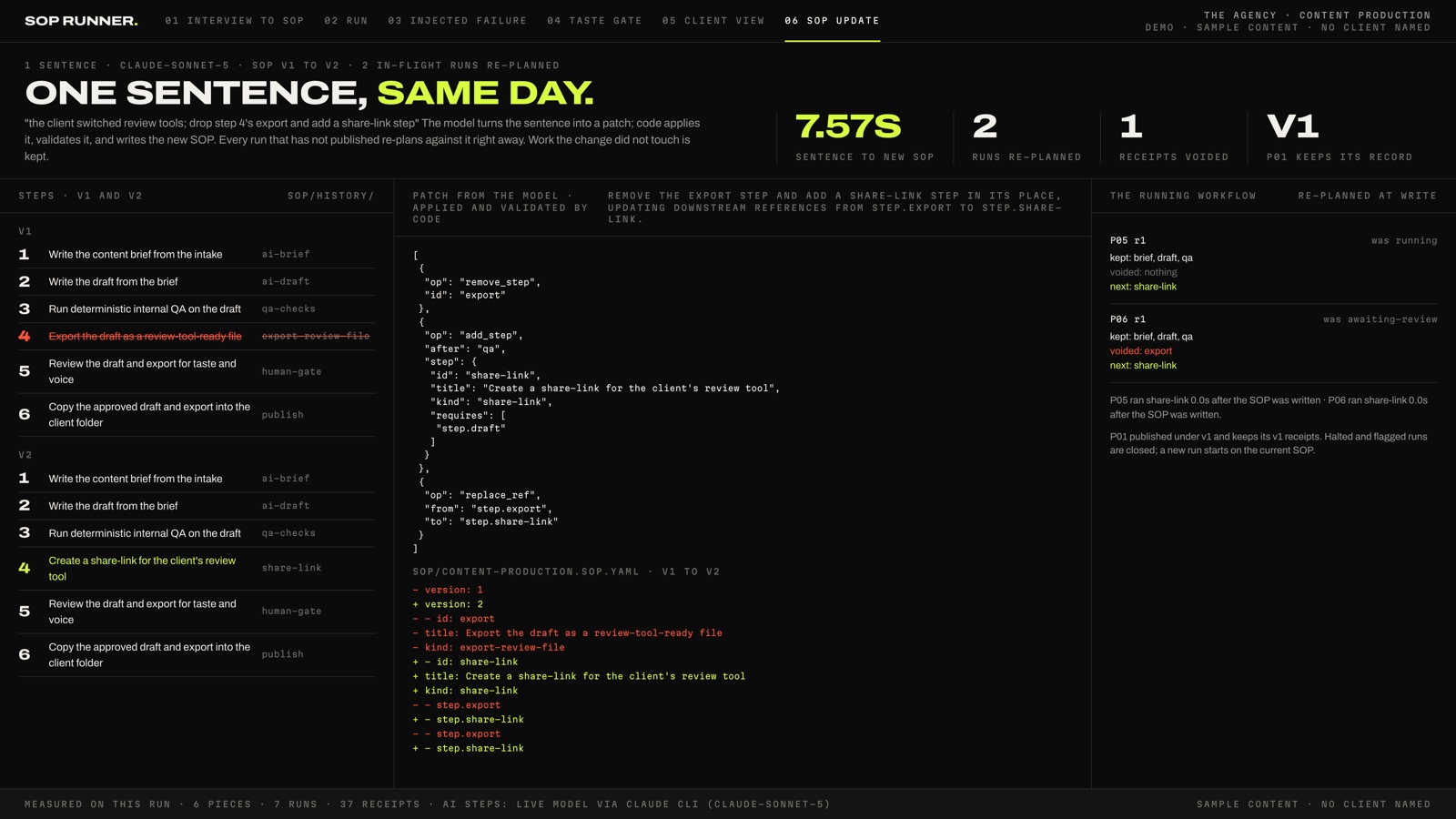
Last, the part that kills most process docs: they go stale. So the SOP updates by sentence. “The client switched review tools; drop step 4’s export and add a share-link step.” The file rewrites itself, and every run still in flight is re-planned onto the new step.
The wobble
The mandate came with a promise attached: the process would never break. The build took that back for us. On an early run, a draft came out with the template’s header block sitting above the headline. All 7 QA checks passed it. The reviewer’s flag kept it out of the client folder, but for a different reason. We added an 8th check. On the next run, the model’s SOP patch named a step in a way the file’s rules don’t allow. The runner refused it, correctly, then stopped with no retry. We added 1. And the draft that was approved in the recorded run writes “three” and “five” where the house style asks for digits. No check looks for that, and the seeded reviewer passed it. So nothing here gets to 0 errors, and you can’t codify taste. The claim that holds up is where it breaks and who sees it: in front of a reviewer, before the folder, instead of in front of the client.
After
Measured on our build, with inputs we wrote and a simulated reviewer, not on anyone’s floor. In the recorded run, the runner wrote 29 work-in-progress files and 8 reached the client’s folder, every one traced by the audit to a sealed approval. The 2 injected failures added 0. The 1-sentence SOP change was written, validated, and live on both runs in flight in under 8 seconds.
What we haven’t measured matters as much. Client-visible failures before and after: a demo can’t measure it. Reviewer time: seeded, so not measured. How codify handles a real founder’s interview, longer and messier than ours: [TK].
The texture is where the change lives. The process stops living in 1 head. The current template is whatever the SOP pins, not whatever is on someone’s desktop. The client folder holds approved work and nothing else, and anything that got in another way shows up in the audit. The founder stops being the queue. And when a client changes review tools, the fix is a sentence, not a retraining.
What it required
The founder in the room, and not as a courtesy. The founder is the only person who holds the full process, so the founder is the only person who can be interviewed for it. Delegate the mandate and there’s nothing to codify.
The founder accepting that the first written version would be wrong in places, and correcting it instead of abandoning it.
The delivery team agreeing their job changes, from running the sequence to judging the work, and that the gate is a real veto. A flagged piece doesn’t ship, deadline or not.
And the client folder held behind real permissions, so the gate is the only way in. The audit reports anything that gets around it; locking the door is deployment work, and the studio owns it.