The RFP response that stopped taking 6 weeks
A 6 week RFP response process became about 30 minutes per proposal. The draft sounds like the agency, and the proposals team edits the rest by hand.
A founder-led digital agency in the Southwest, about 50 people: websites, product design, and the campaigns that launch them. New business runs on RFPs, and every response took 6 weeks. Somewhere around week 4, the strategist writing the approach got pulled back onto a launch, the case studies in the draft were still the ones from the last response, and the founder was rewriting the executive summary at 11pm because it didn’t sound like the agency.
Nobody in that building treated RFPs as admin. Responding to them is how the agency makes money. So a response that takes 6 weeks isn’t an ops annoyance. It’s a revenue problem with a calendar attached.
Before
On paper the process was reasonable. The RFP lands, the new-business team of 2 books a discovery call, and a shared document starts making the rounds: the approach from a strategist, the relevant work from whoever remembers it, bios, a timeline, a price. Then things came up, because things always come up. A launch slipped. The strategist went back to billable work, where a strategist belongs. The document sat. Each of those weeks was defensible on its own, and together they were 6.
The weeks weren’t the whole cost. Everyone who touched a proposal was someone not billing, and the RFPs the agency passed on because the calendar couldn’t take another one never showed up on any report.
They had tried the obvious fixes. A boilerplate library, which made every proposal faster and every proposal read like the last one with a different logo on it. Then a chat tool: somebody pasted in an RFP and got back confident, well-organized prose that could have come from any agency in the country. An evaluation committee spots that register in a paragraph. It went back in the drawer.
The slow part of a proposal was never the typing. It was getting the people who know how the agency thinks into the same document at the same time.
What was done
We didn’t start with the RFP. We started with everything the agency already knew about itself and had never put in one place.
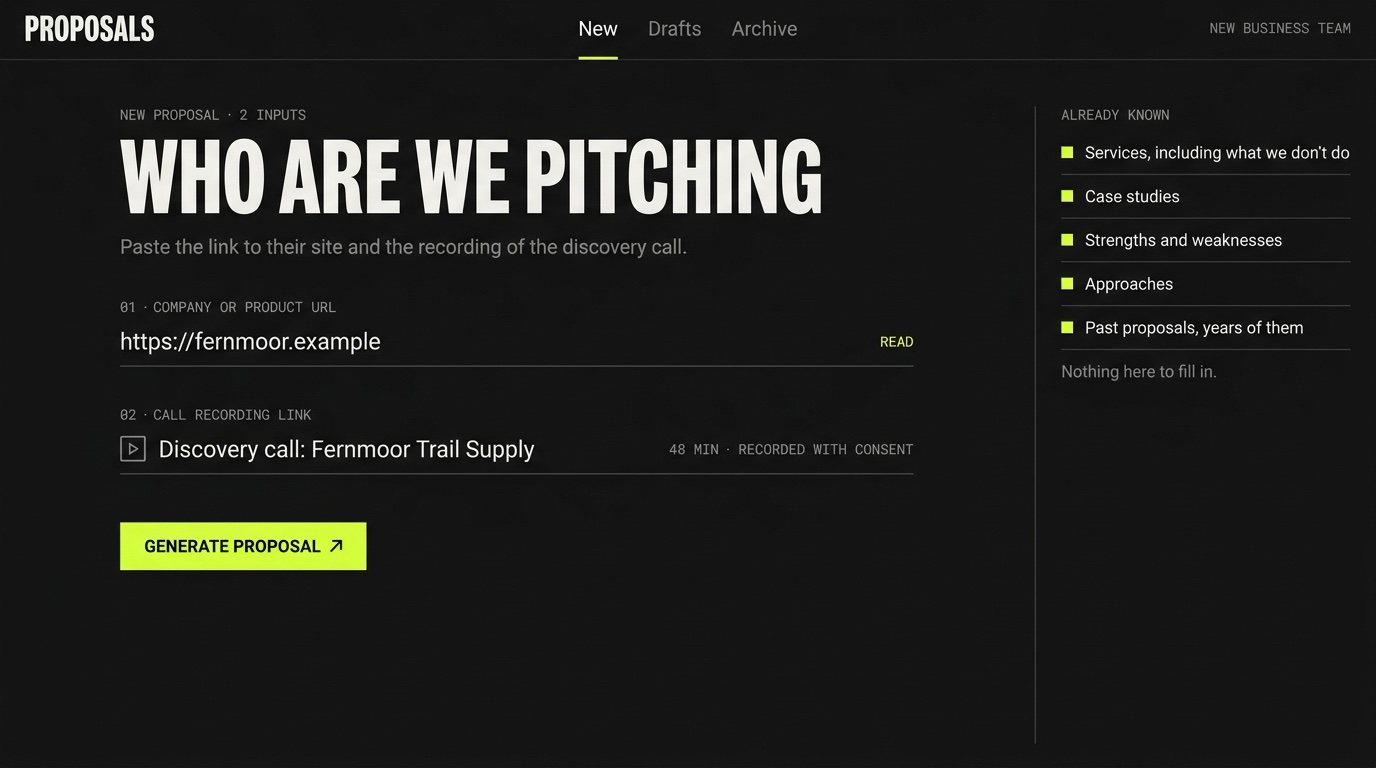
Its menu of services, the real one, including what it doesn’t do. Its case studies. Its strengths and, the harder document, its weaknesses: where it loses, what it shouldn’t bid on. Its approaches, meaning how it actually runs discovery, design, and launch. The system was trained on all of it, so when an RFP arrives, the half of the proposal that’s about the agency is already known.
That’s what let the input side stay small. The generator takes 2 inputs: the URL of the company or product being pitched, for context, and a link to a recording of a conversation between the agency and the client, usually the discovery call. The URL says who they are. The recording says what they actually asked for, including the thing they mentioned twice that the RFP never did.
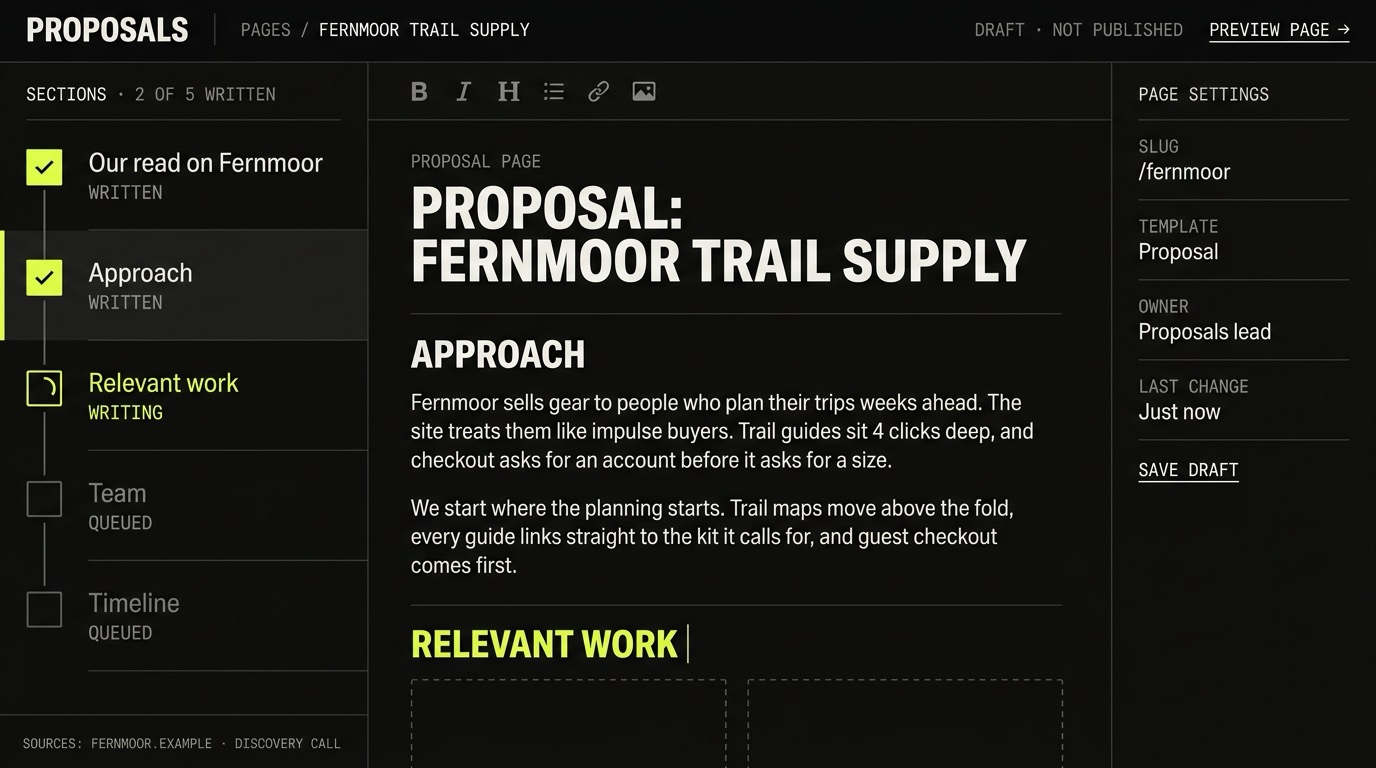
The proposal lives on a website, so the output goes where the proposal lives. The system fills out the site’s CMS section by section: the read on the client, the approach, the relevant work, the team, the timeline. The proposals team opens it in the same editor they’d use for any page and changes whatever needs a human.
That editing step is where the build earns its keep. Every hand edit is recorded along with why it was made. A diff only says what changed. The reason says what was wrong: we lead with their problem, not our awards. We stopped offering that service.
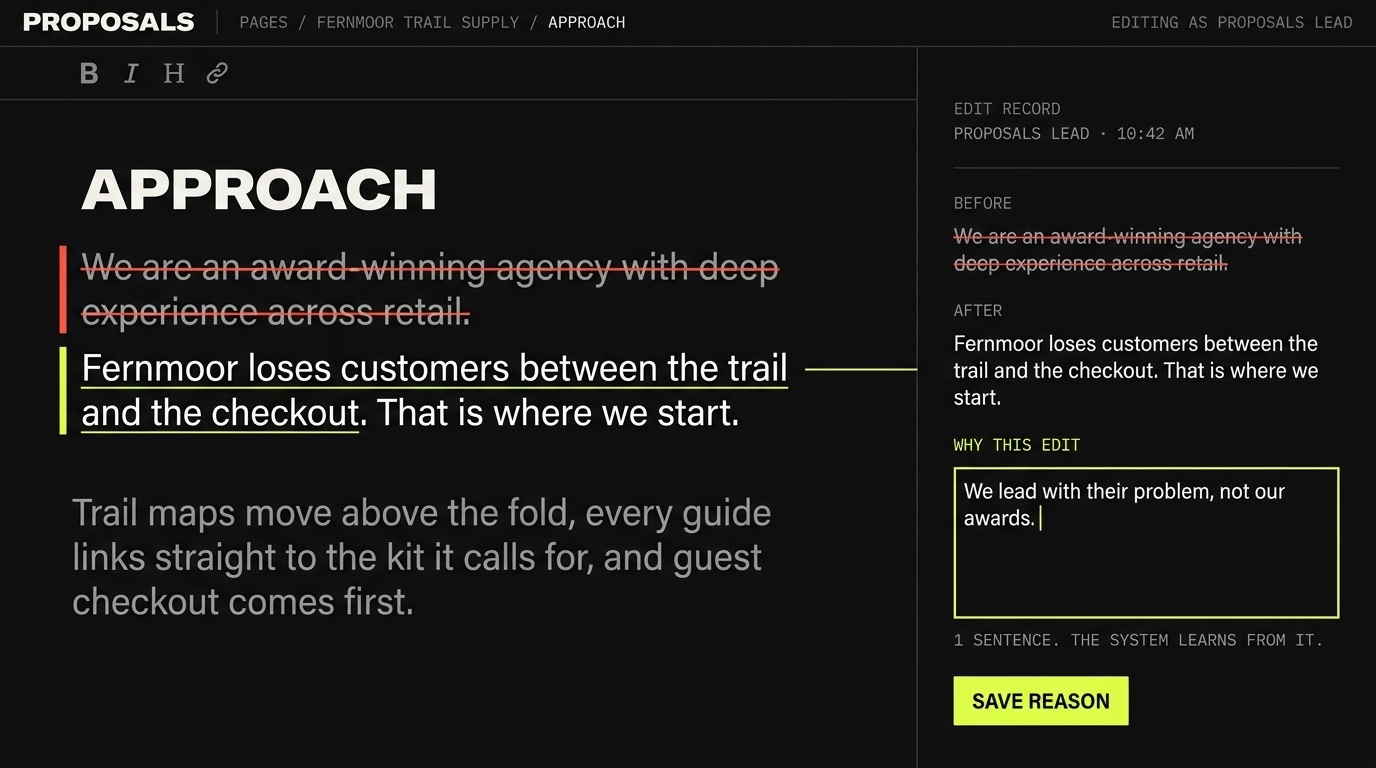
The system learns from those edits, so the same mistake doesn’t come back on the next proposal. The proposals team isn’t asked to train anything, fill out a feedback form, or open a new tool. They edit proposals, which they were always going to do, and write one sentence about why.
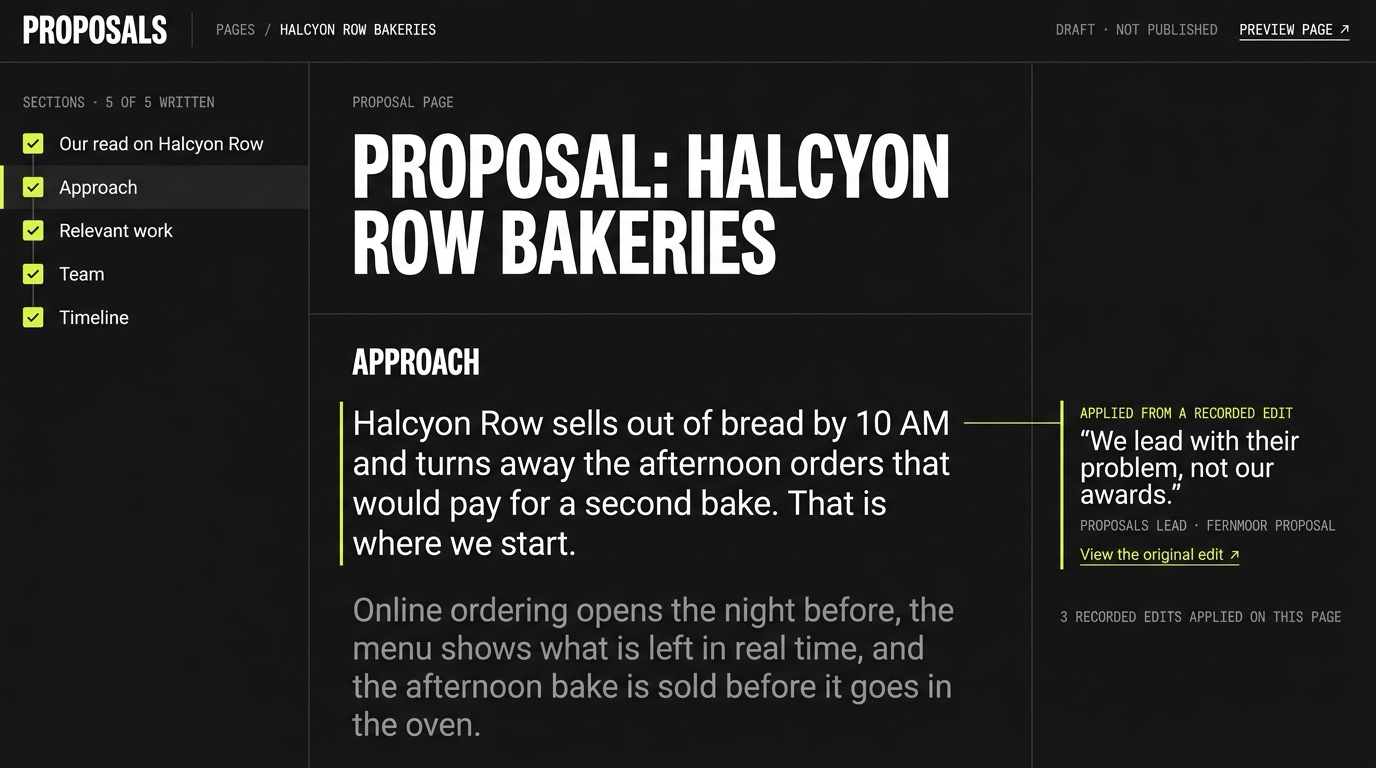
The edits are the training data nobody had to schedule.
The wobble
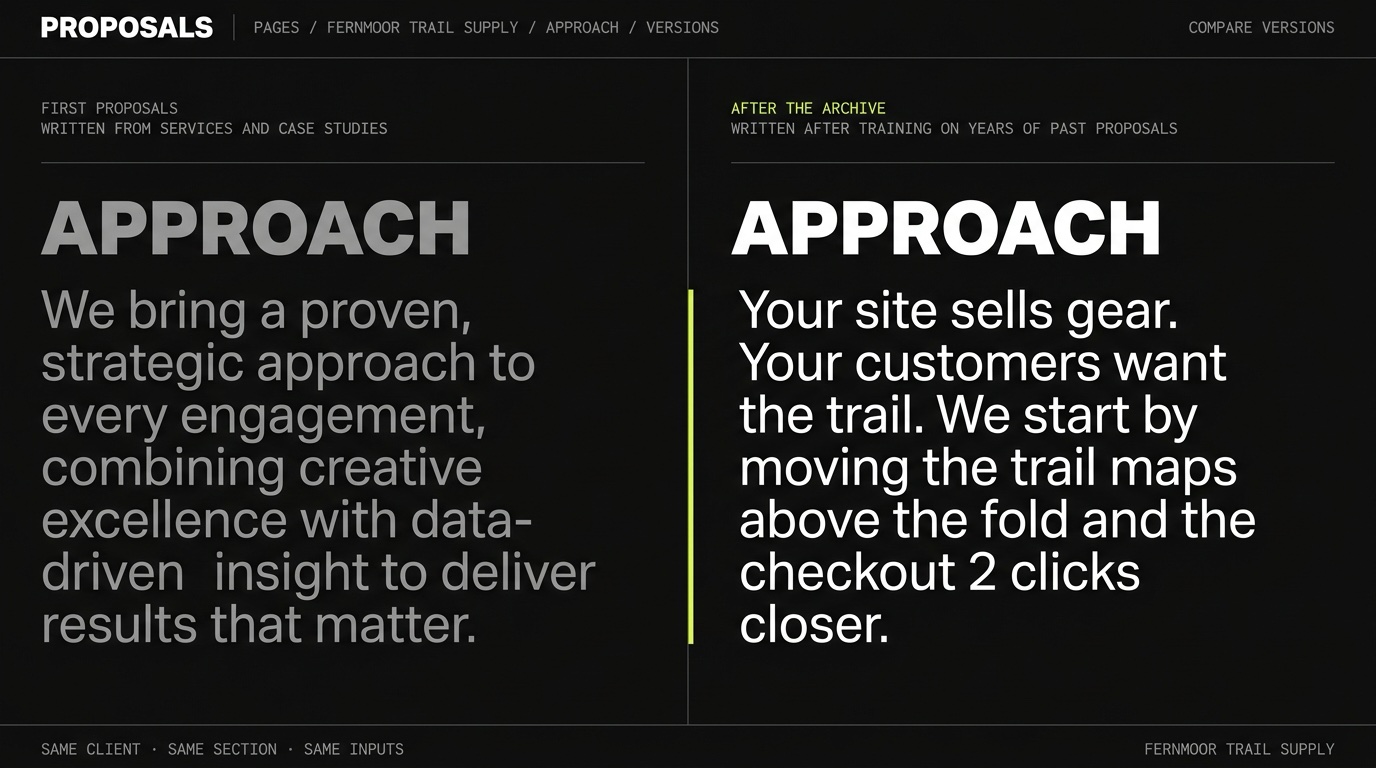
The first proposals came out generic. Not wrong: the services were real, the case studies were theirs, the client’s name was spelled right. They just read like AI, in that smooth, interchangeable register evaluation committees now see in every stack, and anyone who had read the agency’s real proposals could tell inside a page. That was the moment the build nearly became the chat tool they had already given up on. The menu of services and the case studies told the system what the agency sells. They didn’t tell it how the agency talks: where it gets blunt, what it refuses to promise, how it opens an approach section, which sentences it has never once written. The only place that lives is the proposals themselves. So we went back for the archive and trained on lots and lots of the agency’s past proposals, years of them. It stopped sounding like AI only after it had absorbed years of the agency sounding like itself.
After
A 6 week RFP response process became about 30 minutes per proposal. The inputs didn’t grow to get there. Still 2: a URL and a call recording.
Nobody pretends the draft ships untouched. It gets the team most of the way there, and the proposals team edits the rest by hand, which is the design, not a shortfall. Their time moved from assembling a proposal to judging one.
The texture says more than the clock. Strategists stopped getting pulled off billable work to write approach sections from a blank page. The founder stopped rewriting the executive summary at 11pm, because the draft already sounds like the agency. The case studies in each proposal are the ones that fit that client, not the ones from the last response. And the question at the new-business meeting changed. It used to be whether the team could get a response out in time. Now it’s whether this one is worth bidding.
What it required
The founder in the weekly check-in, personally. Nobody else could say with authority what the agency is bad at, and that list mattered as much as the case studies.
The archive, handed over whole: years of past proposals, including the ones nobody enjoys rereading. There is no shortcut, because the wobble proved the voice lives in the archive and nowhere else.
Every discovery call recorded, with the prospect’s consent, because the recording is half the input.
And one new habit, which we won’t pretend costs nothing: a reason on every edit. It’s one sentence. It’s also the whole learning loop, and a team that edits without writing down why gets a system that keeps making the same mistake.